In recent years, we’ve shared a wide range of insights on mixed palletizing, one of our core areas of expertise! But it’s now time to bring everything togheter. This article serves as a complete guide to mixed palletizing, building on our previous content while going further to provide a clear and structured overview of today’s solutions.
Now, we’re expanding and centralizing the conversation to provide a broader, end-to-end perspective on how to approach mixed-SKU pallet building. Whether you’re evaluating your first automation step or looking to optimize an existing setup, this guide will help you navigate the options and understand the trade-offs.

We’ve already explored…
- In-depth comparison between our two high-level approaches to mixed palletizing, solutions that share a similar configuration, with one representing a semi-automated version of the other.
- La palettisation mixte robotisée par couche, offrant un avantage majeur en terme de cadence comparativement aux robots de palettisation conventionnelle.
What’s Driving Retail Distributors to Automate Mixed Palletizing Operations?
Retail and distribution companies are increasingly turning to automation to address a combination of operational and workforce challenges. Here are some pain points that are usually raised by our customers.
- Labor Issues: Labor availability remains a major constraint, along with growing concerns around ergonomics and worker safety in physically demanding tasks such as palletizing.
- Reducing Errors: Automated solutions, particularly robotic systems, help significantly reduce handling errors, improving order accuracy and overall quality.
- Productivity: The need for greater efficiency and faster throughput is pushing distributors to streamline their operations and keep pace with rising demand.
- Load Optimization: Through advanced cubing software algorithms, automated systems can improve load building by determining optimal product placement and sequencing in advance.
What Are the Main Approaches to Mixed Palletizing in Today’s Market?
Various approaches to mixed palletizing are now available on the market, including high-speed robotic layer palletizing, single-pick robotic systems, semi-automated solutions, as well as mechanical palletizers. Each method offers distinct advantages, and the choice between them depends on a variety of operational, financial, and logistical factors. As NūMove does not provide mechanical palletizing solutions, this approach will not be covered further in this article.
All options below with the robot on the floor can easily have a manual top-off station for slow movers and can include a stretch wrapper downstream.

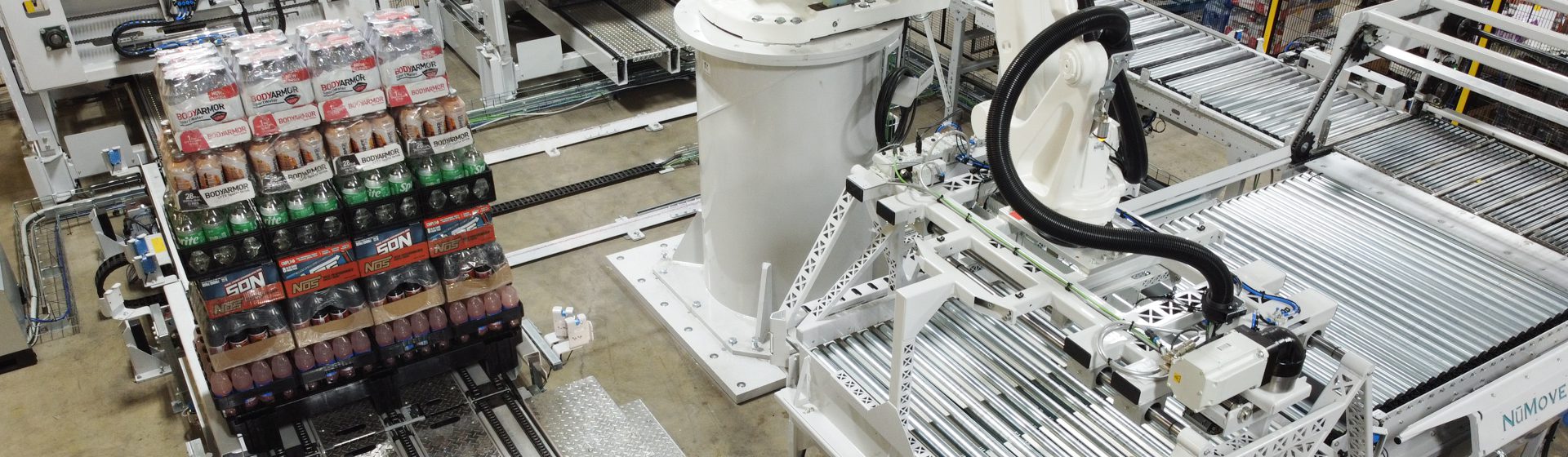
High-Speed Robotic Layer Picking
The floor-level palletizing robot handles full or partial layers that can include different SKUs, enabling an even higher degree of product mix compared to traditional rainbow pallets.
Robotic Single Picking
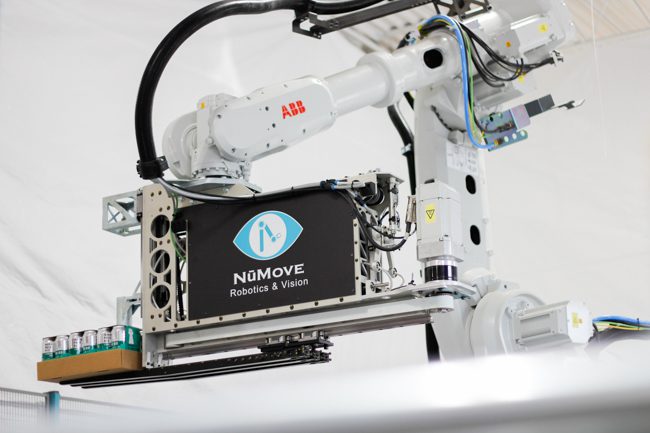
The palletizing robot picks products individually, and the system can be configured in several ways: high-level robot, floor-level robot, specific dual-robot configuration for high-moving products. (see below)

Semi-Automated Mixed Palletizing
While pallet handling is automated, operators palletize with minimal effort on an ergonomic mezzanine. An integrated stretch wrapper enables simultaneous pallet wrapping as the operator continues palletizing. Learn more
Single Picking Palletizing Robot: System Configuration Examples

High-Level Palletizing
NūBotik MixPal: Robot on a platform with an integrated stretch wrapper, where product and pallet handling is performed by conveyors.

Floor-Level Palletizing
Floor-level robot where pallet and product handling is performed either by conveyors or AMRs. A stretch wrapper can be integrated at the cell’s exit.
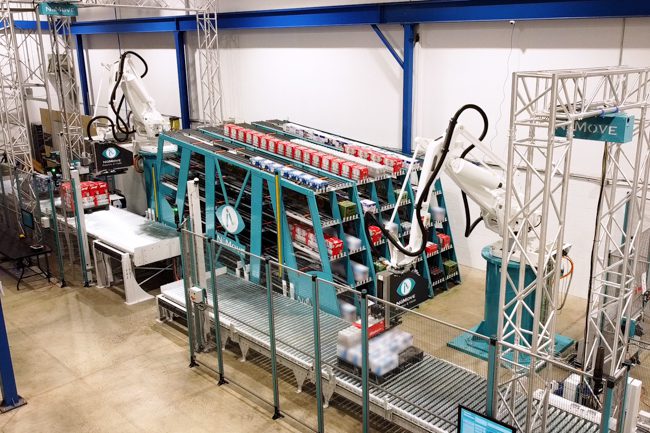
Dual-Robot Solution for Fast-Movers
RAPTOR: A floor-level palletizing robot picks products that are fed into a temporary storage by a depalletizing robot. Pallet handling can be performed by conveyors or AMRs.
Comparative Overview: What Are the Benefits & Disadvantages of Mixed Palletizing Solutions?
- Initial and Operating Costs: Semi-automatic systems generally require a lower initial investment. However, they incur higher ongoing operating costs due to labor dependency. In contrast, robotic systems demand a higher upfront investment but benefit from significantly reduced labor costs over time. For RAPTOR, using conveyors instead of AMRs for pallet handling could result in higher operating costs compared to other robotic systems, due to increased forklift traffic around the cell.
- Labor and Efficiency: Semi-automatic systems rely heavily on human operators, whose performance can vary based on skill, fatigue, and physical limitations. This variability can affect overall efficiency and consistency. Robotic systems offer stable and predictable performance, with the ability to handle repetitive tasks without fatigue.
- Flexibility and Adaptability: Semi-automatic systems excel in environments with large product diversity. Operators can quickly adapt to new products without requiring software updates. Robotic systems can handle an almost unlimited number of SKUs, as long as products meet the constraints of the end-of-arm tooling and peripheral equipment. RAPTOR is an exception, as its standard configuration supports up to 35 SKUs, limited by the capacity of the flow rack storage and other factors. However, accommodating new products may require software adjustments. In addition, flexibility can also depend on the type of upstream automated storage system, if applicable.
- Speed and Throughput: The speed of semi-automatic systems is inherently variable, influenced by operator productivity. Robotic systems, on the other hand, maintain a constant and reliable speed, ensuring consistent throughput. When integrated with upstream product sequencing systems, robotic solutions can achieve optimal cycle times and load efficiency. A single picking robot achieves throughput comparable to two experienced operators with the semi-automatic solution. As expected, layer palletizing offers higher throughput, almost three times faster than the one obtainable with single picking.
- Product Handling and Sequencing: Semi-automatic systems are well-suited for handling randomly arriving cases without the need for sequencing equipment. Robotic systems achieve maximum efficiency when paired with automated storage and retrieval systems (case AS/RS) that deliver products in a pre-determined sequence. Robotic systems can also handle products that arrive randomly when paired with the appropriate software, but load density will be lower while specific stacking rules are difficult to respect.
- Maintenance: Maintenance requirements for semi-automatic systems are minimal and comparable to standard industrial equipment. Robotic systems, while generally low-maintenance, involve more components—such as robotic tools and infeed conveyors—which may increase the likelihood of maintenance needs.
Comparative Overview: What Are the General Features & Capabilities of Mixed Palletizing Solutions?
The following table describes the standard solutions of NūMove’s mixed palletizing systems in terms of footprint, product types handled, number of SKUs, and throughput.
| High-Speed Robotic Layer Palletizer | High-Level Robotic Palletizer | Floor-Level Robotic Palletizer | Semi-Automatic Palletizer | RAPTOR Solution for Fast-Moving SKUs | |
|---|---|---|---|---|---|
| Footprint (Standard Solution) | 27 x 30 ft | 12 x 40 ft | 20 x 30 ft | 12 x 40 ft | 20 x 65 ft |
| Product Types | Cases (closed/open-top), display and perforated cases, wrapped products, wrapped/unwrapped products in trays, shells, totes, etc. | Cases (closed/open-top), trays (wrapped/unwrapped), totes, etc. | Cases (closed/open-top), trays (wrapped/unwrapped), totes, etc. | All types. | Cases (closed/open-top), wrapped products in trays or with bottom pad, unwrapped products or carton boxes in trays, returnable shells, etc. |
| Number of SKUs | Almost unlimited | Almost unlimited | Almost unlimited | Almost unlimited | Up to 35 |
| Throughput (Standard Solution) | Up to 2,200 products/hour | Up to 800 products/hour | Up to 600 products/hour | Up to 1,000 products/hour with 2 experienced operators | Up to 380 products/hour |
Decision-Making Considerations: How Do We Guide Distributors to the Right Mixed Palletizing Solutions?
At NūMove, our role goes far beyond simply providing a solution. Our first priority is to deeply understand each customer’s goals, constraints, and operational requirements. Every distribution environment is unique, and there is no one-size-fits-all approach to mixed palletizing. That’s why we take a consultative, partnership-driven approach, working closely with our customers to define the right criteria and translating them into a solution that truly fits their needs. Through ongoing dialogue and collaboration, we guide decision-making, ensuring that the selected solution is not just technically viable, but aligned with long-term performance objectives.
With that in mind, here are several interrelated factors that contribute to the decision-making:
- Labor Availability: In regions or industries facing labor shortages, robotic systems offer a compelling solution by reducing dependency on manual labor.
- Budget Constraints: Organizations with limited capital may initially favor semi-automatic systems due to their lower cost. However, a comprehensive assessment should consider the total cost of ownership, including long-term labor expenses. Learn more about the cost of inaction in automation.
- Production Goals: For operations prioritizing high throughput and production stability, robotic systems are generally more suitable. As mentioned above, layer picking robots offer the best throughput, but are more suited for handling high movers.
- Product Diversity: Businesses handling a changing range of product types and packaging formats may benefit from the flexibility of semi-automatic systems, which can accommodate new items without reconfiguration. Depending on the SKU mix, the robotic solutions combined with manual top-off could also be considered.
- Upstream Integration: The effectiveness of robotic systems is significantly enhanced when integrated with AS/RS systems. While not essential for semi-automatic systems, such integration can still improve overall performance.
In conclusion, this complete guide to mixed palletizing clarifies the opportunities and considerations for integrating warehouse palletizers. Whether semi-automatic or robotic, these automation solutions offer viable paths to enhancing operational efficiency in distributing environments. The optimal choice depends on a nuanced understanding of the organization’s specific needs, including labor dynamics, budgetary constraints, production targets, and product characteristics. By carefully weighing the advantages and limitations of each approach, distributors can make informed decisions that align with their strategic objectives and operational realities.
Get in touch with NūMove’s experts
More articles…
- NūMove Reaches 20+ Semi-Automatic Mixed Palletizer Deployments Serving Leading U.S. Beverage Distributors
- Mixed Palletizing: Comparing Semi-Automatic vs. Robotic Solutions
- Layer‑Based Mixed Palletizing Fundamentals: Up to 2.5× Faster Than Conventional Palletizers
- NūMove & KPI Solutions Announce a New Robotic Order Picking System for Beverage Warehousing