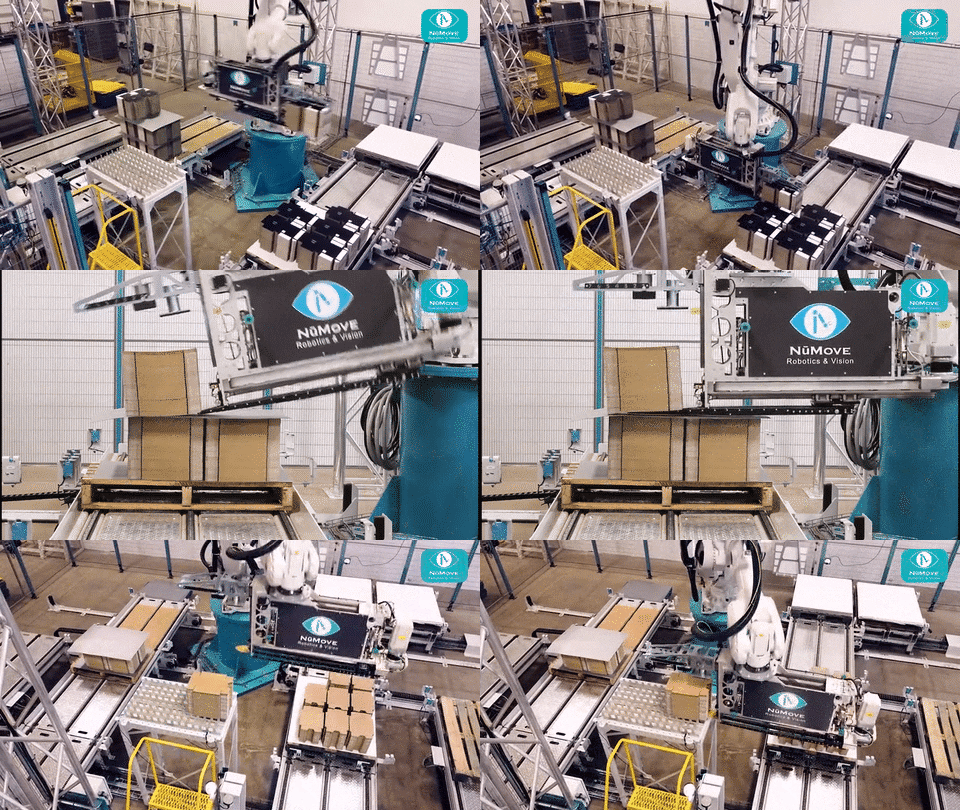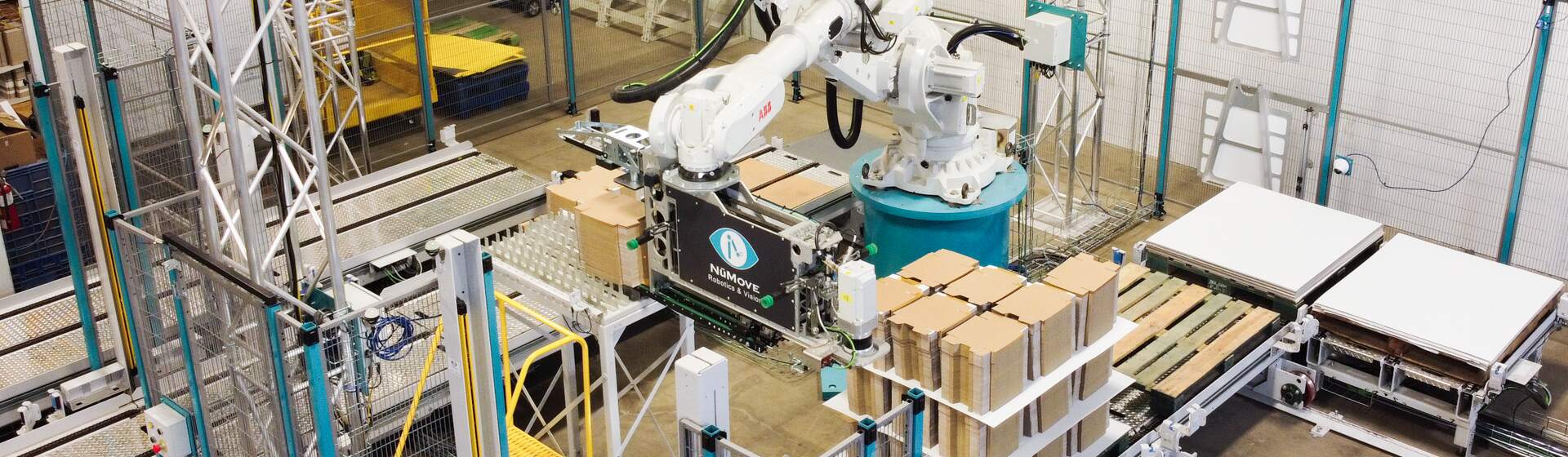
Flat-packing is a common shipping method in folding carton manufacturing. In this article, we explore why carton converting plants often need to destack and restack carton blanks before shipping. We also examine the operational challenges of this traditionally manual process and how robotic automation is enhancing flat-packing operations by improving productivity, consistency, and workplace safety.
Why Is Flat-Packing an Efficient Shipping Method in Carton Converting Plants?
First, let’s set the stage by providing some context on shipping practices in the folding carton industry. Folding cartons are typically shipped using one of two methods: as flat blanks, a process known as flat-packing, or as pre-glued cartons, which are packed into corrugated cases and then palletized for distribution. Below are the main reasons why flat-packing remains a core part of folding carton production and logistics.
- Adapting to end-user production processes: Since many customers erect cartons later, directly on filling or packaging lines, they can remain flat until the manufacturer is ready to use them.
- Minimizing transportation costs & Improving storage density: Depending on the carton geometry, flat-packing can achieve higher transportation and storage densities than pre-glued cartons packed in cases, resulting in lower logistics and warehousing costs.
Why Does Flat-Packing Often Involve Moving Stacks from One Pallet to Another?
In the context of flat-packing, one question often comes up: why do manufacturers remove carton stacks from the die-cutter pallet only to place them onto a different shipping pallet later? At first glance, this step may appear inefficient. To someone outside the folding carton industry, moving stacks from one pallet to another can look like an unnecessary operation. However, in many plants, this process is not wasteful. It is the result of multiple production and logistics requirements that must be met before flat cartons can be shipped to customers.
The key point is simple: in practice, pallet restacking is often required in folding carton production when sheet-fed printing is used, as the downstream die-cutter typically outfeeds and palletizes finished stacks onto work-in-progress (WIP) pallets. These pallets are intended for internal material handling and are not usually suitable for customer delivery.
Why the Die-Cutter Outfeed Pallet Is Usually Not a Shipping Pallet?
The die-cutter outfeed pallet is typically designed to support manufacturing operations rather than customer delivery. In sheet-fed folding carton production, pallet dimensions are largely influenced by press and die-cutter widths, which are commonly around 30, 40, 55, 60 and 65 inches. Moreover, finished stacks are palletized in a manner that is optimized for die-cutter productivity, minimizing carton waste, temporary accumulation, and internal transport.
Because these priorities differ from logistics requirements, the resulting pallet is not always suitable for shipment. Factors such as pallet dimensions, stack orientation, bundle quantity, and layer configuration may need to be adjusted to meet transportation or customer specifications. Consequently, the die-cutter outfeed pallet often serves as an intermediate WIP pallet, requiring restacking before final delivery.
What Are the Advantages of Restacking onto Standard Shipping Pallets?
- Complying to an industry standard: One of the most common shipping expectations is the use of standard 40 x 48 pallets. Customers usually prefer to receive products on these pallets because they are widely used in logistics and transportation. However, as detailed above, the pallets built at the die-cutter outfeed may not match this standard size.
- Maximizing trailer capacity: Trailer dimensions also play an important role. A typical shipping van has an internal width of about 98 to 100 inches. To maximize trailer space, pallets need to be positioned side-by-side in the trailer. This helps achieve maximum cubic utilization and reduces shipping costs.
- Respecting customer requirements: Pallets shipped to customers may need characteristics that differ from the pallets created at the die-cutter. A customer may require a different load height, a different maximum weight, a specific bundle count, or a specific palletizing pattern.
These requirements are not secondary details. They can determine whether a shipment is practical, cost-effective, and aligned with customer expectations. This is why destacking and restacking are often unavoidable. The operation bridges the gap between production efficiency and logistics efficiency.
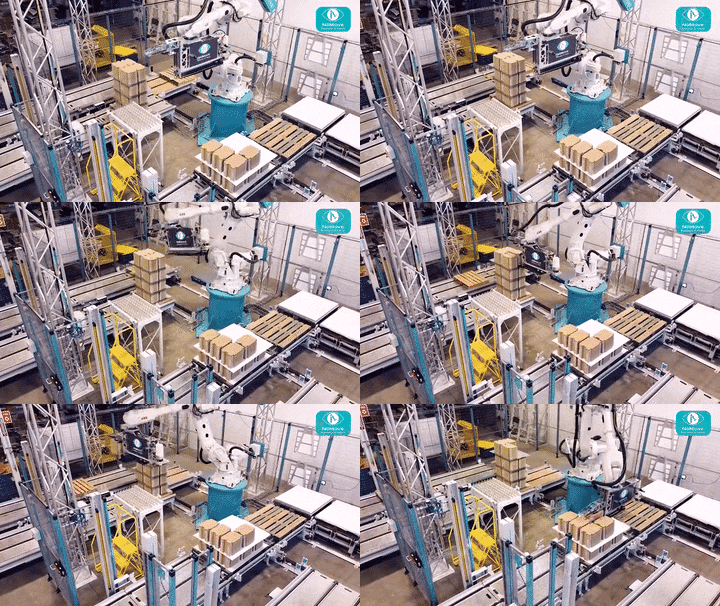
Flat-Packing Enhanced by Robotics: Explore NūMove’s Automated Destacking & Restacking System
What is the Cost of Manual Destacking & Restacking?
Historically, destacking and restacking operations were performed manually. While manual handling can provide flexibility, it also creates several challenges.
- Labor Issues: Workers may need to handle heavy bundles repeatedly. This type of work can contribute to repetitive motion injuries. In addition, labor shortages can make these positions difficult to staff consistently.
- Inconsistency: Manual operations can also create quality inconsistency. When stacking patterns, bundle counts, or pallet characteristics must meet specific customer requirements, inconsistent handling can affect the reliability of the final pallet.
- Production Rate: Throughput is another concern. Manual destacking and restacking can create limitations in the overall process. When these operations cannot keep pace with production, they can become bottlenecks.
How Robotics Is Enhancing Flat-Packing Operations?
Automation is changing flat-packing operations by making destacking and restacking more productive, consistent, and aligned with customer requirements.
- Robotic destacking and restacking directly addresses the mismatch between production pallets and shipping pallets.
- A vision system can support this process by verifying the SKU and validating the stack. These functions help ensure that the correct product is being handled and that the stack is suitable for the next step in the process.
- Automation also supports the formation of customer-ready pallets. Instead of relying on manual handling to reorganize stacks, a robotic system can create pallet patterns according to customer requirements. This is especially important when shipments require specific bundle counts, pallet heights, maximum weights, or palletizing patterns.
- Automatic pallet handling further supports the process by reducing the manual effort required to move and manage pallets.
The Real Purpose of Automating the Re-Palletizing Process
To conclude, in carton converting plants equipped with sheet-fed printing presses, re-palletizing stacks between the die-cutter outfeed pallet and the shipping pallet is often unavoidable. It’s just part of the process! Rather than eliminating this step, automation focuses on optimizing it. Success is measured by how efficiently, safely, and consistently the operation can be performed while maintaining product quality and throughput.