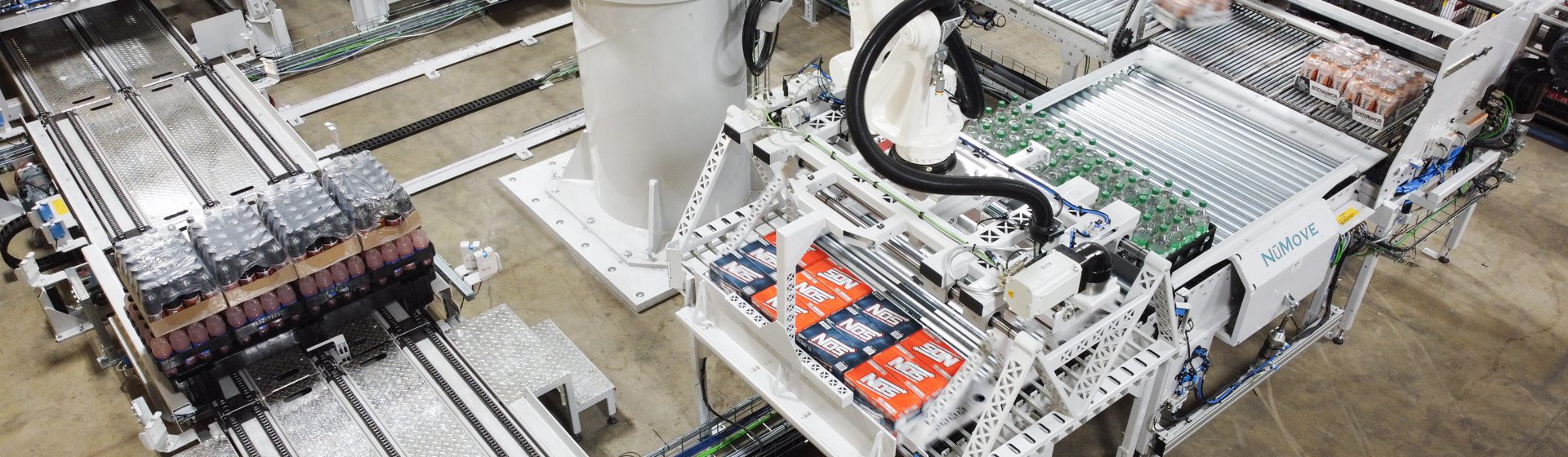
This article explores the principles of mixed palletizing by layer and compares its performance and benefits with conventional mixed palletizing. We explain why this method is gaining strong traction among beverage distributors.
In today’s fast-paced beverage industry, efficiency, flexibility and operational interconnectivity are critical. Traditional mixed SKU palletizing systems often struggle to keep up with growing demands for speed as products are picked individually. Enter robotic multi-SKU palletizing by layer, a solution designed to revolutionize palletizing operations by handling entire layers of mixed SKUs rather than individual cases. This approach delivers significant throughput gains and operational advantages, making it an attractive option for high-volume products moving through distribution centers.
What Is Robotic Multi-SKU Layer Palletizing?
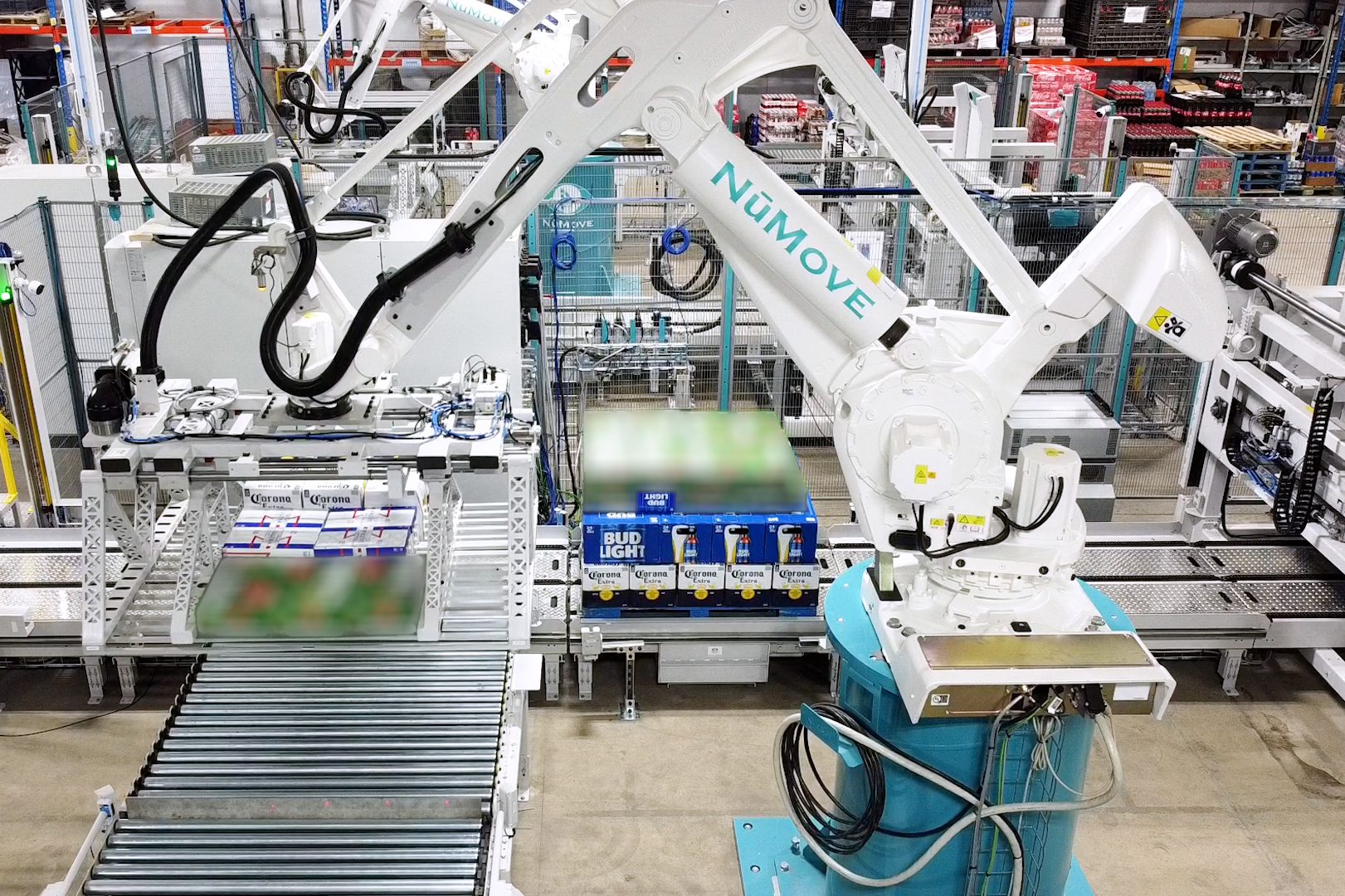
First, let’s go back to the basics: What is a robotic multi-SKU layer palletizer? It’s an automated system that builds pallets of multiple SKUs by stacking entire layers of products. The layer-based approach to mixed palletizing is less conventional than system where robots pick and place products one by one. The layer method achieves 2.0X to 2.5X faster throughput compared to single-case handling, provided that the number of packaging formats is limited. It is particularly effective for high movers in the beer and beverage industry, where speed and consistency are paramount. Lower-volume products can still be manually added downstream of the robot, ensuring flexibility without sacrificing efficiency.
Beyond Rainbow Palletizing
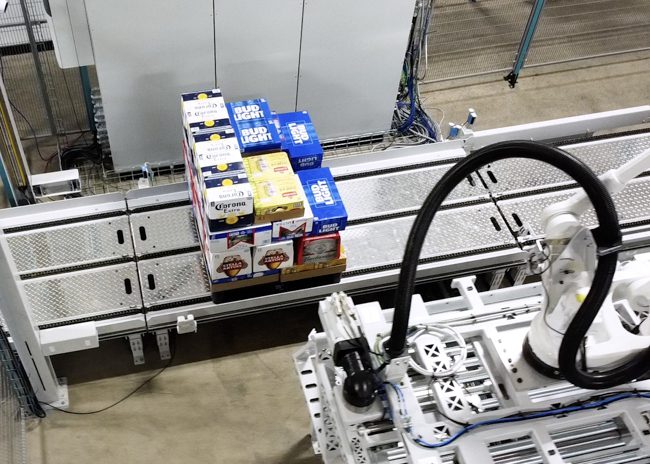
Mixed palletizing by layer is often called “rainbow palletizing”, which involves building a pallet with multiple SKUs, where each layer contains only one SKU. This is where NūMove’s engineering expertise stands out: our robotic solution is designed to handle multiple SKUs even within the same layer.
Why Is this Solution Mainly Applicable for Beverage Distributing?
To enable stacking layers that contain different SKUs, products must follow standardized packaging formats, especially consistent heights. Achieving high pallet density requires that layers may include various product sizes, but their height variations must remain small to allow another multi‑SKU layer to be placed on top. This is why beer and beverage products are ideal for layer based mixed palletizing: their limited packaging formats make it easier to build stable, stackable layers with multiple SKUs.
Because this approach works best with a limited set of packaging formats, it is generally not well suited for grocery and consumer goods operations, where case sizes and packaging styles vary too widely for efficient layer‑level pallet planning. In these environments, mixed‑palletizing systems that handle products individually, such as the NūBotik MixPal, provide the flexibility needed to manage diverse SKU assortments.
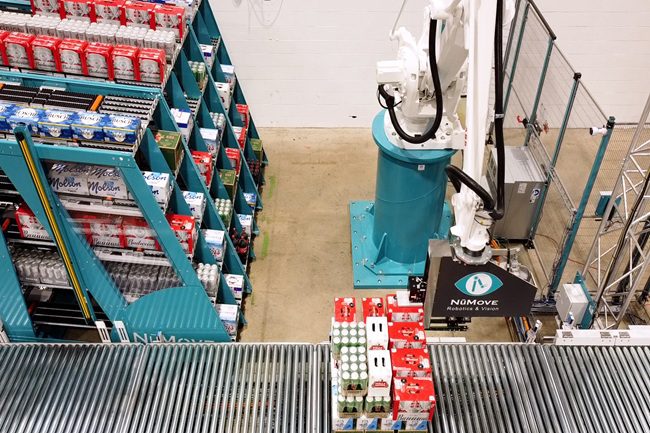
Discover all the robotic mixed palletizing solutions designed by NūMove
What Are the Key Components That Make a Robotic Mixed-Layer Palletizing System Successful?
Implementing a robotic layer palletizing system requires careful planning and specialized equipment. Here are the key components of the system that work together to ensure smooth operation and optimal load stability:
- Cubing software for building stable, dense loads.
- Upstream case AS/RS to supply products in a planned sequence as calculated by the cubing software.
- Layer preparation equipment that includes an orienting conveyor and a row builder / pattern maker.
- Layer pick conveyor for robot access to the layer.
- Fork-type end-of-arm tool with bottom support and clamps to prevent product loss during handling.
- Empty pallet dispensers and pallet shuttle when multiple pallet formats are used.
- Top-off platform for manually adding slow movers’ products.
- Downstream stretch wrapper for load security.

How Important Is the Digital Aspect of a Mixed Palletizing System?
System intelligence is the core of a robotic mixed palletizing solution and the driving force behind its operational performance. Success depends not only on throughput and mechanical design but mostly on two other critical factors:
- Seamless interconnectivity between the physical cell and the warehouse’s digital ecosystem. This integration, particularly with the customer’s WMS/WES, ensures flawless connectivity between upstream equipment, such as a case AS/RS, and ensures accurate product data transfer to the robotic system.
- System intelligence powered by advanced cubing algorithms that optimize load stability and density, while considering important criteria such as product crushability, and compliance with store constraints.
This is where a software solution like NūLogik comes into play! It bridges the palletizing cell and the WMS/WES by translating order data into optimized pallet builds and returning the exact product sequence required to synchronize upstream systems with robotic execution.


Comparing Mixed‑Layer Palletizing to Traditional Mixed‑SKU Systems
When comparing robotic layer mixed SKU palletizers to standard mixed SKU systems, the differences are clear. For operations prioritizing speed and efficiency, layer palletizing offers a compelling advantage if the SKU mix is adequate.
| Mixed Palletizing By Layer | Mixed Palletizing By Product |
|---|---|
| Advantages: Higher throughput, stable load formation, fewer robots for multi-line handling. | Advantages: Maximum SKU flexibility, less upstream equipment, integrated wrapper if robot on a platform. |
| Disadvantages: Limited SKU flexibility, larger robot. | Disadvantages: Lower speed. |
Conclusion
Robotic multi-SKU layer palletizing has become a strategic lever for beverage and beer wholesalers navigating labor shortages, growing SKU complexity, and rising expectations for speed and safety. By automating repetitive palletizing tasks, it boosts throughput, improves ergonomics, and reduces operational risk while delivering consistent, optimized pallet builds.
Looking ahead, solutions that combine high-speed robotic performance with seamless digital integration will define the future of palletizing, maximizing return on investment, strengthening operational resilience, and enabling scalable growth. For forward-thinking operations, this technology is not just an efficiency upgrade, but a future-ready foundation for staying competitive in an increasingly demanding market.
