This article explores the cost of inaction in automation, explaining why delaying automation is no longer a neutral decision for distribution centers and 3PLs. Drawing on multiple research studies, it shows how postponement creates a layered effect: while some impacts—such as labor costs—are immediately visible, more critical consequences, including constrained capacity and reduced operational flexibility, emerge gradually and compound over time.
For decades, distribution centers and third‑party logistics providers (3PLs) have been evaluated on their ability to control costs, meet service‑level agreements, and scale operations reliably. Automation discussions have traditionally focused on labor savings and return on investment, often framed as a question of when the numbers make sense. Increasingly, however, the more consequential question is not the cost of automation, but the cost of not automating or not investing.
Understanding the “Cost of Inaction” in Distribution Operations
The cost of inaction refers to the hidden and often cumulative losses incurred when an organization maintains the status quo despite structural changes in demand, labor availability, and competitive expectations. In distribution environments, these costs rarely appear as a single line item. Instead, they emerge gradually through constrained capacity, rising variability, and strategic limitations that become visible only after opportunities are lost. This concept aligns with academic work on the “Cost of Not Investing” (CONI), which describes how operational and organizational inefficiencies accumulate when firms delay automation beyond purely financial considerations.
The Layered Structure of the Cost of Inaction in Automation
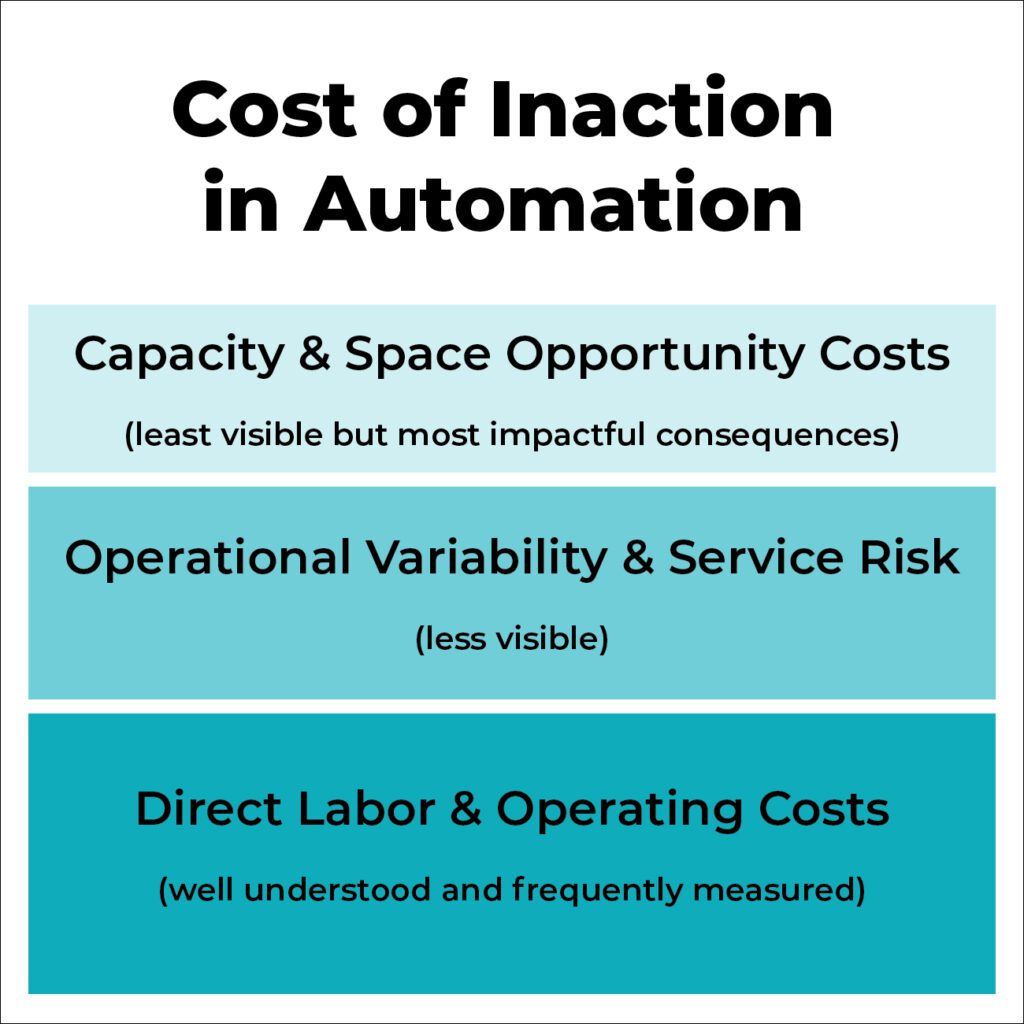
To clarify how the cost of inaction builds over time, it is helpful to view it as a layered structure. At the foundation are the costs that are most visible, tangible, and frequently measured. Above these sit less obvious but increasingly consequential impacts. As decision‑makers move upward through these layers, the costs become harder to quantify and easier to overlook, even though their strategic impact is often greater than the more familiar costs at the base.
The Foundation: Direct Labor & Operating Costs
At the base of the cost of inaction structure are labor‑related expenses. Manual operations scale labor almost linearly with volume, which exposes facilities to:
- Persistent hiring and training cycles
- Overtime during peak demand
- Increased turnover and safety exposure
These costs are well understood and frequently measured. For many facilities, they are the initial trigger for exploring automation. However, focusing exclusively on labor can obscure more consequential constraints further up the system.
Operational Variability & Service Risk
As volumes increase and order profiles become more complex, manual processes introduce variability that is difficult to absorb. Peak periods expose the fragility of labor‑dependent workflows, resulting in:
- Missed service‑level agreements
- Increased error rates and rework
- Inconsistent throughput across shifts
At this stage, the cost of inaction is no longer limited to expenses, it begins to affect customer confidence and operational efficiency.
Academic research on intelligent process automation reinforces this broader view of inaction. A Springer‑published study introducing the concept of the “Cost of Not Investing” (CONI) shows that organizations maintaining manual or semi‑manual processes accumulate hidden costs over time, not only through inefficiencies, but through increased service variability, slower decision‑making, and reduced organizational adaptability. These costs often remain invisible in traditional ROI calculations yet materially affect long‑term operational performance and resilience, particularly in environments characterized by growing complexity and demand volatility.
Capacity & Space Opportunity Costs
One of the least visible but most impactful consequences of inaction is constrained capacity. Distribution centers that rely on manual processes often reach throughput ceilings long before physical space is exhausted. The result is a familiar pattern:
- Growth is accommodated by adding square footage rather than improving flow
- Capital is allocated to buildings instead of operational capability
- Storage density and pick efficiency lag behind demand
Another academic research on warehousing and Logistics 4.0 consistently identifies space utilization and throughput scalability as key benefits of automation, and key penalties when adoption is delayed. A systematic literature review published in the International Journal of Logistics Management highlights that facilities postponing advanced logistics technologies experience persistent inefficiencies in storage density and process flexibility that become increasingly difficult to reverse over time.

Explore NūMove’s warehouse automation solutions, from palletizing, depalletizing and automated storage.
The Productivity Gap That Cannot Be Recovered
A common assumption in distribution strategy is that automation can be implemented later, once uncertainty is reduced or capital constraints ease. University research suggests otherwise. Studies on industrial AI and automation adoption demonstrate that early adopters often experience a temporary productivity dip as systems and organizations adjust. However, over time, these same organizations achieve higher productivity growth than firms that delay adoption. Crucially, late adopters do not fully catch up, even after they implement similar technologies.
Research conducted by scholars from MIT, the University of Toronto, and Stanford describes this effect as a “productivity J‑curve,” where delayed adoption protects short‑term stability but results in long‑term performance penalties. The implication for distribution centers is significant: the cost of waiting is not merely deferred investment, but an irrecoverable productivity gap that compounds over time.
Strategic & Competitive Consequences for 3PLs
System intelligence is the core of a robotic mixed palletizing solution and the driving force behind its opeFor third‑party logistics providers, the cost of inaction carries an additional dimension: competitive positioning.
As shippers increasingly evaluate partners based on scalability, resilience, and technology readiness, automation becomes a qualification factor rather than a differentiator. In this environment, inaction can manifest as:
- Reduced eligibility for automation‑enabled contracts
- Difficulty absorbing customer growth without service degradation
- Loss of tenders to providers with more flexible operating models
These outcomes rarely appear suddenly. Instead, they surface incrementally, often after a competitor demonstrates superior performance during periods of volatility.


Reframing Automation Decisions
The purpose of this discussion is not to suggest that every distribution center or 3PL should pursue the same level of automation. Facility size, order profiles, and customer requirements remain key considerations. However, evaluating automation strictly through near‑term ROI can obscure a broader set of risks associated with standing still.
Research shows that organizations maintaining manual or semi‑manual processes accumulate hidden costs over time. These costs stem not only from inefficiency, but from increased service variability, slower decision‑making, and reduced adaptability as operational complexity grows. Because they are difficult to capture in traditional financial models, they are often underestimated during investment decisions.
In this context, inaction is not neutral. Delaying automation may preserve short‑term stability, but it can also limit a facility’s ability to respond, scale, and remain competitive over time.