
Artificial Intelligence (AI) has rapidly evolved over the past decade, transforming how organizations analyze data, automate workflows, and interact with digital systems. Yet most of this progress has remained confined to the virtual domain: software tools, large language models (LLM), predictive analytics, and generative applications. A new technological shift is now underway, pushing intelligence beyond screens and servers into the physical, operational world: Physical AI.
This emerging discipline is reshaping manufacturing, logistics, and supply chain operations by giving machines the ability to sense, decide, and act safely and autonomously in dynamic environments. As industries adapt to labor shortages, rising operational complexity, and demand for greater flexibility, Physical AI is becoming a strategic cornerstone of modern automation.
3 Categories of AI: Digital, Generative & Physical AI
Before diving into Physical AI, let’s first define the other types of AI. Numerous definitions can be found; we propose here some simple and brief ones.
- Digital AI: Software‑based algorithms that process digital inputs only, historically the most widely deployed AI in industry.
- Generative AI: Models that produce text, images, or videos from natural language input (requests to conversational agents like Copilot, Chat GPT).
- Physical AI: Algorithms that interact with the real world by processing data from sensors and actuators within physical systems, such as robots and automated handling equipment.
What Is Physical AI: How Is it Transforming Robotics across Manufacturing & Warehousing?
Physical AI is the most challenging and transformational of the three AI categories described above, and its impact is increasingly visible across manufacturing and warehousing. As highlighted by the World Economic Forum: “Until recently, most industrial robots were designed for fixed, repetitive tasks in controlled settings. That’s beginning to change. With Physical AI, robots are gaining the ability to perceive, learn and respond to more complex environments while supporting a wider range of tasks and use cases.” (World Economic Forum, 2025).
Traditionally, industrial robots execute planned and preprogrammed sequences. Whenever the context changes, such as introducing a new product to palletize, the program must be updated. Adaptation, therefore, requires manual intervention and tightly controlled conditions. Physical AI fundamentally shifts this paradigm.
How physical AI changes the paradigm?
By integrating perception, learning, and real‑time decision‑making, Physical AI enables automation systems to go beyond rigid sequencing and instead understand, interpret, and adapt to variability—something historically difficult for industrial robots. This adaptability is particularly valuable in applications such as mobile robotics in dynamic environments, depalletizing systems handling varying packaging, and bin‑picking tasks with unpredictable product orientations.
Operating in Real World, Unstructured Environments
More broadly, Physical AI allows robots to operate reliably in unstructured or changing environments. Vision, real time sensing, and adaptive algorithms let robots handle irregular packaging, variable product placement, changing lighting, unexpected obstacles, and other forms of real world variability. As a result, capabilities are expanding across palletizing, depalletizing, quality inspection, machine tending, and autonomous material movement.
Enhancing Human–Robot Collaboration
Physical AI also enhances human–robot collaboration. Machines equipped with spatial awareness and adaptive behavior can interact more naturally and safely with workers. For example, on assembly lines, operators can issue simple instructions for real time adjustments. As labor shortages persist across industries, this combination of flexibility, safety, and autonomy is becoming increasingly important for maintaining operational performance.
Ultimately, while Physical AI is not strictly required for robots to adapt, it greatly simplifies and accelerates adaptability across a wide range of applications, unlocking new possibilities for automation in environments that were once too variable or unpredictable for traditional robotics.
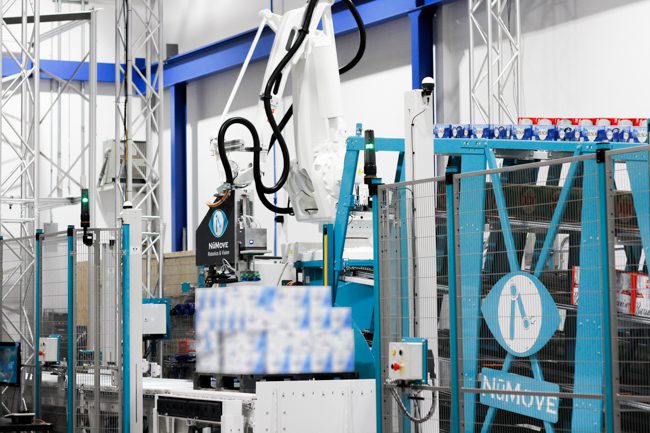


For additional details about physical AI in distribution centers, read this article:
Physical AI Implies A New Threshold of Reliability
One of the defining characteristics of Physical AI is the level of robustness it requires. Digital AI can tolerate certain inaccuracies because a human can always confirm, correct, or ignore a flawed output. In industrial settings, however, such errors have real-world consequences. A misinterpreted image, for instance, could cause a robot to drop a product. If it’s a plush toy, the error is trivial. If it is a case of bottled beer, the mishandling can lead to damaged goods, production interruptions, and even workplace hazards.
Because of these risks, the reliability threshold for physical AI must be near perfect before it is deployed. This contrasts sharply with generative AI which, according to the Quebec AI Institute (MILA), “were not designed to say things that are true, they were designed to say things that sound good.” (MILA, 2024).
What sounds plausible is not acceptable in operations. What is correct is what matters.
What Are the Training Challenges of Physical AI?
Physical AI also faces challenges that digital AI does not. Traditional algorithms rely on large datasets to achieve high performance. Many digital AI systems benefit from the abundance of online information or large-scale internal logs. In physical environments, exceptions and non-standard situations occur far less frequently. Factories are designed for consistency, and distribution centers aim to reduce variability. As a result, the data needed to train robust physical AI models, especially for edge cases, is often rare or unavailable.
This is why the field is moving toward approaches such as “zero-shot learning”, where systems interpret and act on unfamiliar scenarios without being retrained. Physical AI of the future must be capable of learning effectively from small datasets, adapting its internal models as it observes more of the real world.
Supplementary research, including systematic reviews from TechRxiv and ResearchGate, confirms that simulation tools, foundation models for robotics, and hybrid learning strategies will play increasingly important roles in addressing data scarcity challenges in industrial environments.
What Are the Technical Foundations for AI Successful Deployment?
The successful implementation of Physical AI rests on several technical pillars.
- First, perception accuracy must remain consistent even under imperfect environment conditions such as dust, reflections, or inconsistent presentation of items. Vision systems can help ensure this level of robustness.
- Second, the decision-making component of the algorithm must prioritize correctness over approximation. In digital AI, an incorrect suggestion can be ignored; in Physical AI, a “near-right” decision can be harmful.
- Algorithm robustness is also essential. Real production environments introduce vibrations, product shifts, and packaging damage that can affect performance. Image‑processing algorithms must therefore adapt to these conditions to maintain reliability.
- Finally, AI’s learning efficiency, particularly the ability to generalize from limited data, will determine whether AI-driven automation can scale effectively across diverse applications.
Conclusion
Physical AI is redefining what automation can achieve. It extends intelligence beyond digital boundaries and embeds it directly into industrial operations. Adopting physical AI requires careful attention to robustness, data limitations, and real‑world reliability. But the payoff is significant: more flexible robots, safer operations, improved efficiency, and resilience in the face of labor and demand variability.
As manufacturing and supply chain environments grow more complex, Physical AI is poised to become a foundational technology. Organizations that embrace it will be better positioned to increase resilience, reduce manual strain, and unlock the next generation of intelligent automation.