A Catalyst for High‑Mix & High‑Variation Order Preparation
In this article, you’ll discover how modern distribution centers integrate AI to improve their operations. We also dig deeper into how AI, combined with software and machine vision, helps solve the complex challenge of preparing mixed‑SKU orders.
Artificial intelligence (AI) is rapidly transforming the way distribution centers operate. Once considered experimental, AI has entered modern warehouse environments, driven by measurable operational gains and increasing confidence across the industry. According to the 2025 MHI Annual Industry Report, 28% of respondents already use AI in their warehouse operations, and adoption is expected to grow to 82% by 2030. More than half of respondents (52%) believe AI has the potential to disrupt the industry or generate a competitive advantage.
As AI becomes more accessible and powerful, its impact is most visible in the practical improvements it brings to everyday tasks in distribution centers.
How Is AI Used in Today’s Distribution Centers?
AI, and more recently physical AI, is now used at multiple levels within modern distribution centers, enhancing several key warehouse functions. Here are a few examples:
- AI supports pick‑and‑pack processes by analyzing workflows and improving the sequencing of tasks.
- AI strengthens replenishment activities by anticipating stock movement and reducing the likelihood of interruptions.
- Software-assisted decision-making, combined with AI-driven optimization, also makes vehicle routing more dynamic, adjusting to real-time conditions on the floor (forklifts, AMRs, AGVs, or pallet trucks).
- Machine vision systems, a major subset of AI, play an increasingly crucial role. Their ability to identify, classify, and locate products means they can adapt to ever-changing packaging, product formats, and SKU variations. This flexibility is essential in industries where product life cycles and packaging updates occur frequently.
The trend is clear: AI is less about futuristic automation and more about making existing operations more efficient, adaptable, and resilient.
Physical AI as a Catalyst for High Mix & High Variation Order Preparation
Order pallet preparation is one of the most compelling cases demonstrating AI’s value. Let’s look at the context behind this.
- What is the main challenge related to order preparation?
Many distribution centers and fulfillment centers prepare mixed‑SKU orders for retail partners, stores, or online consumers. The task requires high levels of accuracy, especially when operators or robots must pick items from donor pallets, totes, or cases. - How was this challenge addressed in the past?
Traditionally, every new SKU, or even a simple change in packaging graphics, required manual updates to image processing programs. This approach created operational bottlenecks and increased reliance on specialized programmers. - How does AI help overcome the order preparation challenge?
Let’s talk about AI-driven machine vision. Instead of relying on fully predefined rules, AI learns to recognize products regardless of packaging changes. Whether a label is redesigned, a promotional graphic is added, or a seasonal color variant appears, the system continues operating without additional programming.
Examples of AI‑Driven Vision for Order Preparation
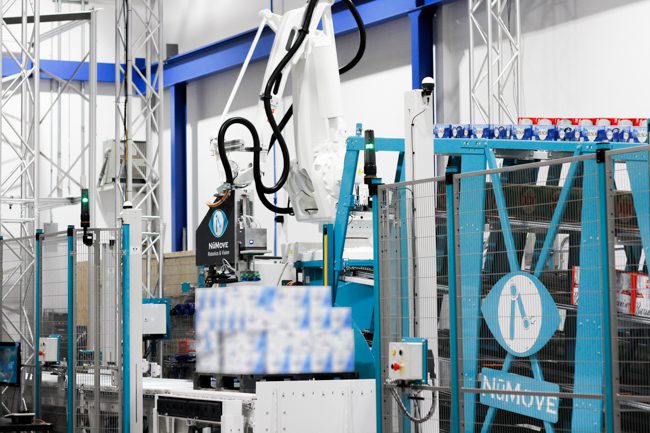
A practical example can be seen in the depalletizing part of RAPTOR, a dual-robot solution that automates the order preparation of fast-moving beverages like beer and soda. The depalletizing robot picks individual products from a donor pallet and feeds a temporary buffer. Using AI-powered image processing, the system identifies and locates the next product to pick, even when new packaging is introduced. No additional input from programmers is required to adapt to new SKUs.

This flexibility is equally valuable in e-commerce environments. When preparing a multi-SKU shipping case for end consumers, AI enables automated systems to recognize items instantly, even when new colors or graphics appear, without halting operations for software adjustments. That was the case in the Robotic Pick & Pack illustrated in the image above.
Why AI & Software Form a Strong Combination?
AI’s capabilities become even more powerful when integrated into broader warehouse software ecosystems (WMS / WES / NūLogik Software). Software systems provide structure and orchestration, managing replenishment, sequencing orders, or optimizing pick paths, while AI adds adaptability to real-world variability.
This combination ensures operational continuity even when product lines evolve quickly. Workflows remain stable and efficient, allowing distribution centers to react to SKU variety without the need for constant intervention.
Key Advantages Summary of AI-Driven Order Preparation
- Versatility: AI-enabled systems can accommodate new packaging graphics without requiring programming updates. This adaptability reduces downtime and ensures fluid operations even in environments with frequent product refreshes.
- Ease of Use: Warehouse teams no longer need to contact vendors or programmers whenever a product design changes. AI handles visual variability through training, allowing the system to continue operating smoothly.
- Future Readiness: Because new SKUs and packaging variations appear constantly, distribution centers benefit from a system that can evolve with market changes. AI provides this capability, making order preparation more resilient over time.
Conclusion
AI has moved beyond the realm of conceptual innovation and is now a reliable, practical tool enhancing operations within distribution centers. Its ability to handle packaging variability, support efficient workflows, and reduce programming dependencies demonstrates its real-world value.
As SKU diversity continues to rise and customer expectations tighten, physical AI offers an adaptable, future-ready foundation for order preparation and other warehouse functions. It strengthens existing automation, allowing organizations to maintain high throughput, respond quickly to product changes, and operate with greater confidence across their distribution networks.